
The Investigation’s Reconstruction
Chanson douceNina Dorval tries to turn scattered testimonies and domestic evidence into an intelligible account of a crime whose emotional cause remains hidden.
increasing Bearing strength in each event
 decreasing
Bearing strength in each eventdecreasingFirst on the Scene

The Investigator Arrives
A controlled entrance
Nina Dorval reaches the apartment as responders take the children and Louise away. She clears onlookers and assigns tasks to the officers.
Evidence beside intimacy
The investigator enters a home still filled with children’s objects and domestic disorder. The scene resists the distance of an abstract case because every room records ordinary family life interrupted.
Witness Accounts

Conflicting Human Memories
Rose’s recollection
Rose Grinberg remembers Louise acting unusually quiet in the elevator but insists she did not appear drunk or visibly dangerous. Her account becomes haunted by the possibility that she might have changed events.
The limits of hindsight
The police and lawyers challenge Rose’s vision, judgment, and importance. Her remorse cannot establish what she could have known before the crime.
The Supermarket Recording

Ordinary Images Replayed
A mundane errand
Nina studies supermarket footage showing Louise buying milk, biscuits, and wine while the children run nearby. Louise appears calm and does not visibly attend to them.
Suspicion takes shape
Repeated viewing makes small gestures seem meaningful, but the recording cannot disclose Louise’s thoughts. Nina sees a possible pattern of detachment while confronting the danger of reading a familiar act backward from its outcome.
The Murder Weapon

Identifying the Knife
A family object
Nina shows Paul a photograph of the small ceramic knife. He recognizes it as a gift from Thomas, kept out of the children’s reach and rarely used.
Evidence of access, not motive
The identification explains how the weapon belonged in the home but cannot by itself show when Louise took it or why. Domestic familiarity becomes a forensic fact without resolving the central psychological question.
The Reenactment
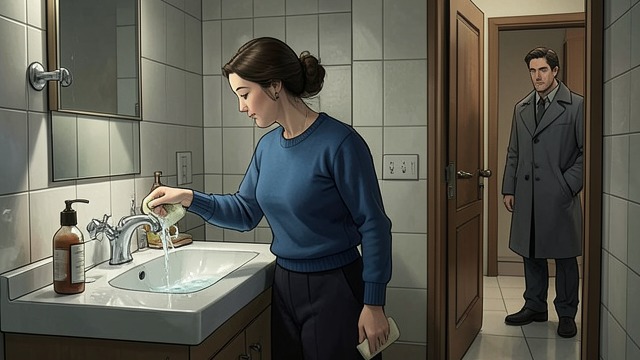
Repeating the Routine
Nina takes Louise’s role
Nina plans to reproduce the bath sequence and test how the children might have responded. She hopes the physical scene will reveal a clue that interviews and records have not provided.
Understanding remains partial
The reenactment culminates in a familiar invitation to bathe. Reconstructing the gestures does not grant access to Louise’s mind, leaving the investigator with procedure rather than certainty.
Minutes after the emergency call
The first weeks of the investigation
During the search for Louise’s movements
After Paul is questioned
The morning of the planned reconstruction
